
Ask a committee what their club website needs and you get a long list: news, a gallery, a sponsors page, a history section, a shop, a contact form. Most of it gets built once and never touched again. Meanwhile the two questions people actually turn up to answer, who we play this weekend and whether we won, sit three clicks deep or go missing entirely.
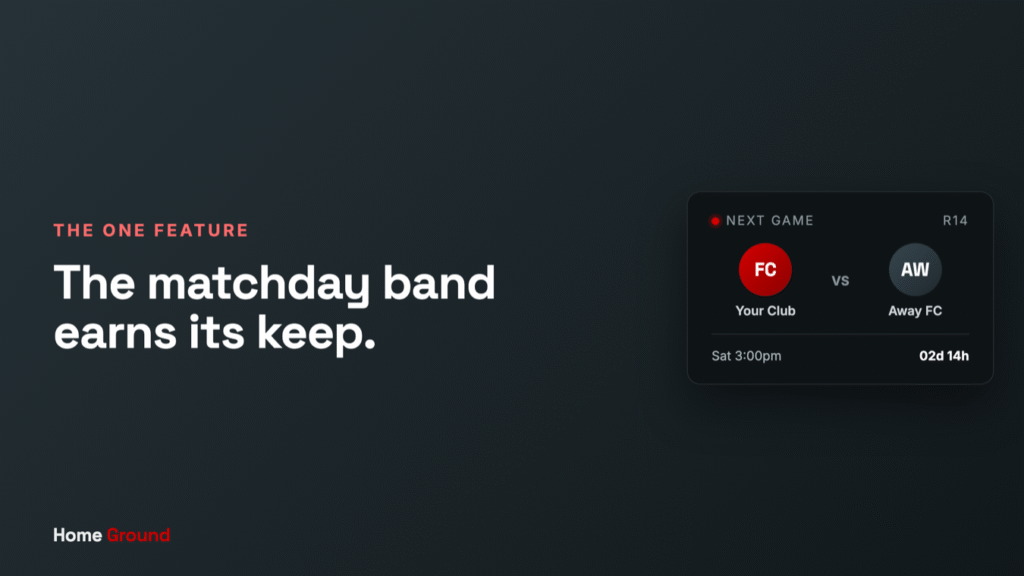
That gap is why we keep coming back to one feature above all the others: a live matchday band pinned to the top of every page. It shows your next fixture, your last result and your ladder position, pulled straight from the competition data and updated on its own. It is one of the most-used parts of a club site, and it is the one most clubs skip.
What a matchday band actually is
A matchday band is a slim strip across the top of your website, sitting above the header on every page. It carries three things in real time:
- Next fixture: opponent, date, time, venue, home or away.
- Last result: the score from your most recent game, with a link to the report.
- Ladder position: where your senior teams sit right now.
The point is that it never goes stale. A volunteer does not log in on a Sunday night to type in the score. The band reads from the competition platform your league already runs on. In Victoria that means Dribl, which is where Football Victoria publishes every fixture, result and ladder for 2026. Junior and community competitions elsewhere sit on PlayHQ or GameDay. Your website reads from that source and displays it in your colours, so the number on your site matches the number in the app, every time.
That last part is the difference between a feature and a headache. A manually updated fixtures page is wrong within a week. A connected band is right without anyone touching it.
Why it beats the usual club website features
Most club website features are built for the committee rather than the visitor: an about page, a constitution PDF, a committee photo from three seasons ago, all useful once and rarely opened again. The matchday band flips that. It answers the questions people came for before they have to go looking.
Think about who lands on your site during a season. A parent checking where the under-13s play on Saturday, an opposition supporter working out the venue, a local wondering how the seniors are tracking before they come down, a sponsor’s staff member sent a link. Every one of them wants current, factual, glanceable information, and the band gives it to them in the first second, on the first screen, without a scroll or a click.
We build these for the clubs we work with, including Essendon Royals SC in red and white and Green Gully SC in green and white, and the pattern holds. The band becomes one of the most-clicked elements on the site. News gets read, but the fixture and the result get checked again and again through the week.
Live data or it does not count
Plenty of platforms will let you show fixtures on a website. PlayHQ, for instance, has widgets that display your fixtures, ladders and results and sync from the competition data automatically. That auto-sync is the whole game. A feature that pulls live is an asset. A feature someone has to keep current by hand is a liability that quietly falls out of date until people stop trusting it.
When you are weighing up club website features, put every one of them through a single test: does it update itself, or does it need a volunteer? Anything in the second bucket has a short life. Committees turn over, the person who owned the fixtures page moves on, and the page rots. Live-connected data survives the handover because there is nothing to hand over.
The matchday band passes that test by design. It is wired to the same feed the league publishes, so it is as current as the official app, and it costs your volunteers nothing to keep running.
Your website and your app doing the same job, together
A common question we get: if members already use a club app for fixtures, why does the website need the band too? Stack Team App, formerly Team App, is a free tool clubs use to spin up an app in minutes, and GameDay sits alongside it for competition data. Apps work well for members who have already opted in and installed something.
Websites do a different job. They catch everyone who has not, the searcher, the first-timer, the opposition, the sponsor, the parent who is not going to download an app to find a kickoff time. Your website is the front door and the app is the members’ lounge. The matchday band means both show the same live fixture and result, so nobody gets a different answer depending on where they look. That consistency is part of what makes a club feel run properly.
What it does for sponsors
A matchday band is also one of the most valuable pieces of sponsor real estate on your site, and most clubs miss it. Because it appears on every page and gets looked at constantly, a small “matchday sponsor” credit sitting inside the band is seen far more than a logo parked on a sponsors page nobody opens. You can rotate it, tie it to the round, or hold it for your major partner. It gives you something concrete to sell beyond a static logo wall, and it gives the sponsor a reason to believe their money buys attention rather than a listing.
That turns a feature which helps visitors into one that helps the club balance its books, the kind of double duty a volunteer committee should demand from anything it builds.
The takeaway for your committee
You do not need more club website features. You need the few that earn their place, and the matchday band is near the top of that list because it is heavily used, always current and the hardest to let go stale. Build that first, connect it to the data your league already runs on, and let everything else sit behind it.
If you want to see one working on a real club site with live fixtures, a result feed and your own colours, book a look at Home Ground and we will walk you through it. We build it, host it and keep it current, so your committee never has to.
FAQ
What features should a football club website have? Start with the ones people actually use: a live matchday band showing your next fixture, last result and ladder position, then news, a sponsors section and clear registration links. Prioritise anything that updates itself from your competition data over anything a volunteer has to keep current by hand.
Can I show live fixtures and results on my club website? Yes. Fixtures, results and ladders published on platforms like Dribl in Victoria, or PlayHQ and GameDay for many junior and community competitions, can be surfaced on your own website. How cleanly depends on the platform, and Dribl is the smoothest of them today so the numbers match the official source and update on their own.
Is a club website still worth it if we already have an app? Yes, because they reach different people. An app serves members who have installed it; a website catches searchers, first-timers, opposition supporters and sponsors who never will. A matchday band keeps both showing the same live information.
How often does the matchday band need updating? Never, by hand. It reads from your competition feed, so the fixture, result and ladder refresh on their own as the league publishes them. That is the point of building it live rather than as a page someone edits each week.
Does a matchday band help with sponsorship? It can. Because it appears on every page and gets checked constantly, a matchday sponsor credit inside the band earns far more visibility than a logo on a sponsors page, giving you something worth selling to a partner.